Thursday, 9 April 2015

The best way to treat stress over the long term is to identify the root causes of it, and see if your lifestyle can be changed to reduce it. However sometimes it is difficult to determine the source of your stress due to the fact that there might be reasons which are overlapping during the day e.g. work ,children, school, safety, money. Therefore one of helping methods, which I would like to recomend is consumption of herbal remedies. There are herbs and teas which can be used to calm and reduce stress. Below just a few examples:

LAVENDER -  it is effective at reducing anxiety and stress. Moreover it can help to balance hormones as well as has a positive impact on immune system.

CHAMOMILE – very popular for wide range of healing properties. It relieves stress and helps maintaining good night sleep. It is also used to sooth stomach.


PASSION FLOWER – it is used to treat sleep disorders, anxiety and depression. The herb is also known to decrease muscle tension.

MINT - has proven effective in relieving stress and inducing calmness.
There are plenty of other herbs and teas which are widely used in order to relax and achieve inner peace e.g.: licorine root, kava kava, barley tea, valerian root, catnip, lemon balm, hoops, green tea etc.


Friday, 6 March 2015

This blog is linked with previous one, as it briefly describes one of methods, which can help you relieve stress. I am not going to focuse on how much you can earn once you become massage therapist or how often people get injured during massage due to the fact that massueses are not qualified (one week course, pay and get certificate).
I am going to answer three questions: what?, when?,why?

Massage therapy is the scientific manipulation of the soft tissue of the body in order to ease tension and decrease pain.

Massage therapy dates back thousands of years. References to massage appear in writings from ancient China, Japan, India, Arabic nations, Egypt, Greece and Rome. Massage became broadly used in Europe during the Renaissance. In the 1850s, two American doctors who had studied in Sweden presented massage treatment in the United States. In the 1970s, massage treatment was very popular particularly among players. Nowadays widely known therapy is used by many people all around the world. 
Massage can help relax painful and tight muscles, enhance circulation, improve immune system activity, and play a role in restoring normal digestive system function. There are many types of massage, and below you can find just the few of them:
  • Hot Stone Massage
  • Deep Tissue Massage
  • Shiatsu
  • Sports Massage
  • Swedish Massage Therapy
  • Shiatsu
  • Aromatherapy Massage

Monday, 5 January 2015

There are many causes of stress in life and we should learn to recognize what are the “stressors” as well as how to deal with them.
So what are the methods to deal with stress:
RELAXATION- for some people to relax means sitting in front of TV but you should do something more than that in order to relieve stress.
There are plenty of relaxation techniques, below just few of them:
·         deep breathing
·         meditation
·         massage
·         yoga
·         tai-chi
·         aromatherapy
·         music
Recently I have tried deep breathing technique and sometimes it works, however my favorite one is music. It has a very unique connection to our feelings and emotions. Music is very powerful soothing tool which has an impact on our body and mind.
“Nothing is miserable unless you think it so; and on the other hand, nothing brings happiness unless you are content with it” Boethius.

Living you with that thought …, until my next blog.

Sunday, 4 January 2015

Chronic stress is a threat to health!


Segen’s Medical Dictionary defines chronic stress as a state of prolonged tension from internal or external stressors, which may cause various physical manifestations

I have mentioned in previous blog that human body is able to cope with stress called acute stress, however when it becomes too much it may lead to serious health problems. If the stress-response system is constantly active and your body is frequently exposed to stress hormones the autonomic nervous system does not have opportunity to initiate the relaxation response, and what comes after that is disruption for body’s processes.

Chronic stress can cause various health problems e.g.: high blood pressure, heart disease, sleep problems, anxiety, depression, digestive problems, ulcers, backache, headaches.

If you want to avoid psychological and physical consequences of prolonged stress you should find a best method how to control chronic stress. This will be the topic for my next blog. I am going to explain some of the methods, which are used to deal with stress. For many of us there are well known, however quick guide might turn out to be interesting subject for some of you.

Thursday, 27 November 2014

Stress  - body respons


I believe most of us know how our body reacts to stress. However in this blog I write about this- just as a remainder. I am not going into details here:)

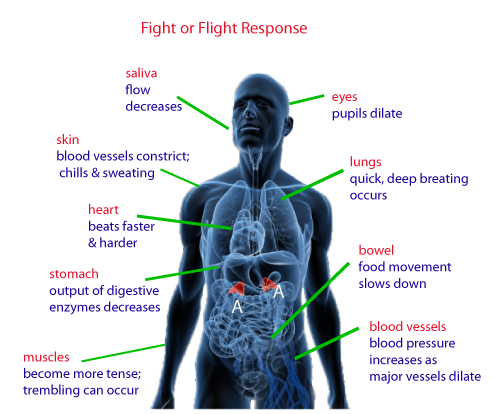
Reaction to stress is an example of cooperation between the sympathetic and parasympathetic nervous system.
Any kind of fear, tension and stressful situation acts through the brain on hypothalamus,
which releases a hormone that stimulates the pituitary gland to secrete adrenocorticotropic hormone ACTH and this one stimulates adrenal glands to produce cortisol.
Cortisol is a hormone which regulates the metabolism of organic compounds.

Through the sympathetic part of the autonomic nervous system adrenal medulla is stimulated and adrenaline is released. Adrenaline is a hormone which:
  • increases blood pressure,
  • increases the level of glucose in the blood,
  • accelerates metabolism of fats,
  • causes vasodilatation in skeletal muscle and constriction in the skin and abdominal cavities
  • bronchodilation,
  • acceleration of breath,
  • expansion of the pupils.

Our body is prepared for short-term reaction to stress. However we have to remember that
chronic stress is a threat to health and this is going to be a topic of my next blog.
Two more blogs about stress and I am going to change a subject otherwise you will never read my blogs :):):):):)


Sunday, 23 November 2014

STRESS


 What is stress?
This time I am going to write about stress and of course some of you will notice that this topic is linked to our last communication classes.
I just want to find out more about stress and share my thoughts with you on that subject.
 Today I am going to focus on one question:
-What is stress?
The word, “stress,” was coined by Hans Selye in 1936. He defined it as the “non-specific response of the body to any demand for change.”
Stress is part of our life and very often we experience it as unpleasant and very negative.
Everyone can feel stress and we might see it as reaction to situations when we have to cope in order to fulfill demands which are on our way.
Definition of stress in Oxford Dictionary “A state of mental or emotional strain or tension resulting from adverse or demanding circumstances”. On the one hand this is
just definition of stress but on the other it could be description of somebody’s everyday life.

An interesting way of perceiving stress presents Dalai Lama “If there is no solution to the problem then don't waste time worrying about it. If there is a solution to the problem then don't waste time worrying about it.”- if only we could put this into practice, life would be much easier.

It should be mentioned that stress is much more than just a feeling which we have to deal with. It is biological process in our body involving our nervous system and hormones . If you wish to find out more please ready my next blog which should be posted in few days time.


Friday, 31 October 2014

My first blog is about book, which was recomended to me few years ago by my dearest friend Sarah. I have to add that ”The Prime of Miss Jean Brodie” by Muriel Spark was one of my first books which I have read in English. My son Daniel has started primary school this year and I think this is the reason why I am going back to my Scottish friend Sarah and this book. 
           Some people might say it is just a light, easy to read plain story about a teacher but it isn't for me. There is something that is hidden and becomes clear only to the one who is able to read between lines. It is actually very complex and fascinating story which was included in a ranking of the best 100 English-language novels. I will intoduce you with  my view and maybe one day you might decide you are going to read it. 
           Miss Jean Brodie is a teacher in one of Edinburgh’s schools in 1930s, where we closely follow her together with “the Brodie set” which consist of six ten-year-old girls.
Firstly Miss Jean Brodie appears to me as a wonderful teacher, who wants to teach girls something more than what is written in a curriculum. ”To me education is a leading out of what is already there in the pupil’s soul.” Instead of books she uses her stories, life experience, trips and love life as main source of knowledge and also she discusses quite complicated as for ten year olds issues of sex and Mussolini Fascist regime. 
As I read further, I start to recognize that she is not all so great in her “prime”. It seems to me that she starts to show some psychopathic attributes by using girls in her own games. Although she is very clever at doing that sometimes she is losing control. It is noticeable that she doesn’t want to be just a good role model but she wants the girls to be like her and to follow her values and believes. Eventually Miss Brodie is betrayed by Sandy and is loosing her job on the grounds of teaching Fascism.
        What happens to girls who were forming “Brodies set”? Mary becomes a typist, Eunice a nurse, Monica a scientist, Jenny engages in acting career; Rose gets married to handsome man. Sandy becomes a nun and now is called Sister Helena. She is an author of “The Transfiguration of the Commonplace” which is a strange book of psychology.
  I found this novel interesting but also challenging. I think it shows how important are teachers in children’s lives. They have a huge influence on personal and psychological development of their pupils and most of all they have a big impact on their future.